
Words to Wellness Mental Health Practitioners Guide
- Home
- Resources
- Mental Health Practitioners Guide
Table of Contents
Clinical Overview
The Words to Wellness platform contains a structured database of over 9,000 guided clinical letters and dialogue scripts across major life problem categories. Designed by a licensed clinical social worker with over 40 years of experience, these scripts act as externalized communication templates.
In a clinical setting, these WTW letters serve as externalization vehicles helping clients who experience cognitive overload, emotional flooding, or poor communication assertiveness to structure their internal thoughts into actionable, non-defensive dialogue.
Integration Framework for Clinicians
1. Assessment & Category Selection
Identify the patient’s primary relational or situational stressor (e.g., boundary setting, conflict resolution, grief, workplace distress). Direct the client to the relevant WTW Life Problem Area Category and subcategory to pinpoint the letter topic matching their emotional state.
2. Script Assignment & In-Session Customization
Drafting phase: Have the client select a baseline WTW letter template from the 9,000+ library.
Therapeutic intervention: Use session time to evaluate the chosen script:
• Cognitive restructuring: Identify where the original template might trigger cognitive distortions or defensive reactions in the client sender or potential receiver.
• Customization: Use guided WTW instructional templates to tailor the letter to the client’s specific voice and personal boundary goals.
3. Behavioral Rehearsal (Role-Playing)
• Use the customized WTW script as a scaffold for in-session role-playing.
• Practice verbal delivery of the WTW script to build distress tolerance and interpersonal effectiveness (DBT focus).
• Assist client to identify areas of the WTW script that directly validate the client’s feeling states or helps them express thoughts they were unable to formulate on their own.
Clinical Safety & Supervision Protocol
Clinical Boundary & Safety Protocol
WTW communication scripts and letters are supplementary tools for interpersonal skill-building. They do not replace formal treatment or emergency intervention. Clinicians should pre-screen assigned letters to ensure they are safe and appropriate for high-conflict or volatile interpersonal situations (e.g., active domestic abuse).
Protocol 1: Clinical Pre-Screening & Risk Assessment
Before assigning web-based reflection or utilizing the WTW 9,000+ letter/script database, clinicians must conduct a pre-screening assessment to ensure client readiness and safety.
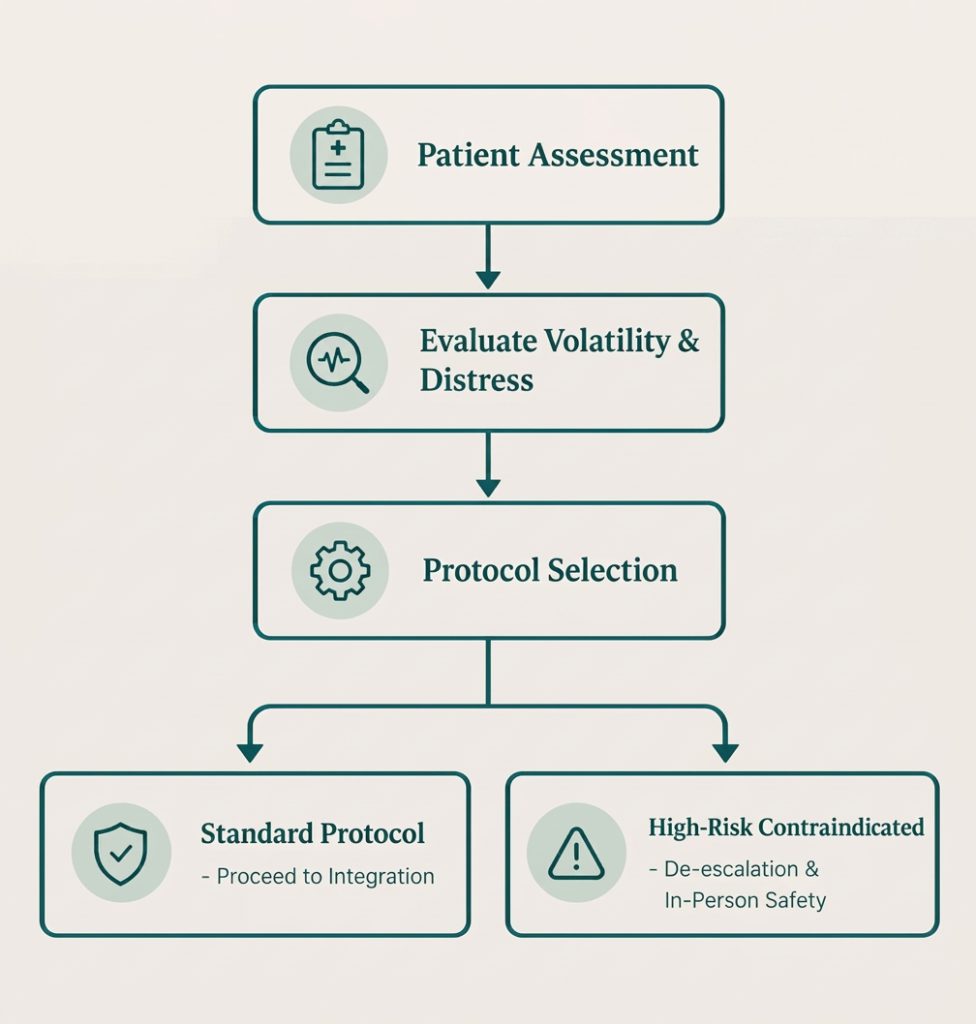
1. Inclusion Criteria
• Client exhibits low-to-moderate emotional dysregulation during interpersonal conflict.
• Client experiences cognitive flooding, social anxiety, freeze response, or difficulty with assertive communication.
• Client possesses sufficient literacy and digital hygiene skills.
2. Contraindications & High-Risk Exclusions
• Acute Psychosis or Severe Dissociation: Written assignments may increase internal fixation or paranoid ideation.
• Active Suicidality or Self-Harm: Digital tools must be paused in favor of crisis de-escalation and safety planning.
• Active Intimate Partner Violence (IPV) / Domestic Abuse: Direct communication scripts should not be delivered to an abusive partner, as boundary-setting letters may escalate physical risk.
Protocol 2: The 4-Phase Script Integration Workflow
This standardized clinical workflow governs how a therapist introduces, adapts, and reviews a script from the WTW 9,000+ library across treatment sessions.
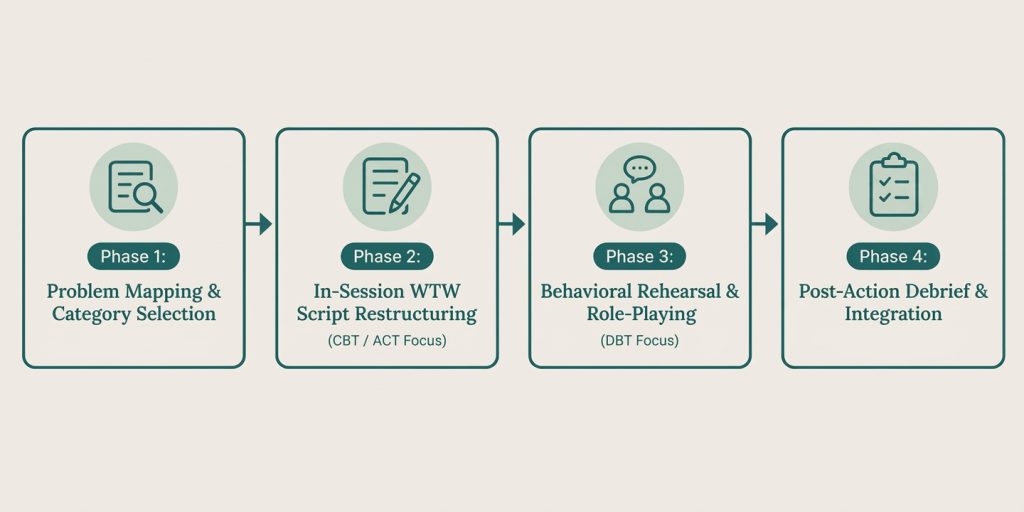
Phase 1: Problem Mapping & Category Selection
Identify Interpersonal Focus: During intake or session review, identify specific interpersonal blocks (e.g., setting boundaries with family, workplace conflict, grief/unexpressed emotion).
Database Navigation: Direct the client to the relevant WTW Life Problem Category within the 9,000+ library to select a baseline WTW letter or dialogue template.
Phase 2: In-Session WTW Script Restructuring (CBT / ACT Focus)
Identify Cognitive Distortions: Review the chosen baseline WTW template with the client. Check for catastrophizing, accusatory language, or covert emotional dumping.
Refine for Assertiveness: Modify the WTW template to ensure it adheres to objective, non-defensive communication standards (e.g., using “I” statements, stating concrete facts, defining explicit boundaries).
Phase 3: Behavioral Rehearsal & Role-Playing (DBT Focus)
Role-Play Execution: Conduct a (10-15) minute role-play where the practitioner plays the recipient and the client reads/delivers the adapted WTW script.
Distress Tolerance Evaluation: Assess the client’s physiological arousal (SUDS scale 0-10).
Phase 4: Post-Action Debrief & Integration
Outcome Analysis: In the subsequent session, analyze the outcome of sending the WTW letter or speaking the script.
Reframing Responses: If the recipient responds negatively, focus on the client’s internal validation and adherence to their core values rather than external approval.
Protocol 3: Modality-Specific Application Matrix
| Psychotherapeutic Modality | WTW Script Application | Clinical Mechanics | Target Clinical Outcome |
|---|---|---|---|
| Cognitive Behavioral Therapy (CBT) | Script Deconstruction | Compare client’s automatic thoughts with objective WTW script statements. | Identify and restructure Cognitive Distortions (e.g., Mind Reading, All-or-Nothing thinking). |
| Dialectical Behavior Therapy (DBT) | Interpersonal Effectiveness Scripts | Map WTW script structures onto DEAR MAN / FAST / GIVE skill modules. | Increase assertiveness while maintaining self-respect and relationship balance. |
| Acceptance & Commitment Therapy (ACT) | Values-Aligned WTW Writing | Edit WTW templates to align explicitly with core client values rather than reactive anger. | Enhance psychological flexibility and reduce experiential avoidance. |
| Trauma & Unsent Letter Therapy | Externalization & Narrative Processing | Utilize unsent WTW scripts to express unresolved grief, anger, or past hurt in a controlled environment. | Facilitate emotional processing and exposure without real-world risk. |
Utilize grounding exercises (e.g., box breathing, 5-4-3-2-1 sensory technique) if SUDS exceeds 6.
DBT Skills Reference
Dialectical Behavior Therapy (DBT) interpersonal effectiveness skills break down into three acronyms, each used when a different priority is at play:
• DEAR MAN: Used when your priority is the objective (getting what you want).
• GIVE: Used when your priority is the relationship (keeping the peace or staying close).
• FAST: Used when your priority is self-respect (sticking to your values).
DEAR MAN
Describe: State the objective, factual details of the situation without judgment or exaggeration.
Express: Share your feelings and opinions using “I” statements rather than blaming the other person.
Assert: Clearly ask for what you want or say “no” directly, without expecting others to read your mind.
Reinforce: Explain the positive consequences or benefits of getting what you want or having your request met.
Appear confident: Use a steady voice, maintain good eye contact, and adopt an upright posture that shows self-assurance.
Negotiate: Be willing to give to get. Offer compromises or ask the other person for alternative solutions to reach a middle ground.
Mindful: Stay focused on your primary goal. Do not get distracted, and repeat your point or “broken record” if the other person tries to change the subject.
GIVE
Gentle: Approach the conversation without attacks, threats, or judging. Avoid sarcasm, eye-rolling, or passive-aggressive behavior. Express your thoughts calmly and tolerate a “no” if necessary.
Validate: Acknowledge the other person’s feelings, thoughts, and situation, even if you do not agree with their stance. Use validating phrases like, “I understand this is a stressful time for you.”
Act Interested: Show that you genuinely care about the other person’s perspective. Face them, maintain appropriate eye contact, practice active listening, and avoid interrupting or talking over them.
Use an Easy Manner: Keep the tone lighthearted and approachable. Smile, use a little gentle humor when appropriate, and choose a “soft sell” over a heavy, confrontational approach.
FAST
Be Fair: Be fair to both yourself and the other person. Make sure the script validates your own feelings just as much as theirs.
No Apologies: Do not apologize for making a reasonable request, having an opinion, or setting a boundary. Eliminate phrases like “I’m sorry to bother you, but…”
Stick to Values: Stand firm on your personal integrity, morals, and what you believe is right. Do not compromise your core principles to fit in.
Be Truthful: Be completely honest. Make sure your script choice avoids exaggerating, acting helpless, or making up excuses to avoid a confrontation.
How It Fits Together
In DBT Interpersonal Effectiveness, you choose your approach based on your primary goal:
• DEAR MAN is used when your priority is the objective (getting what you want).
• GIVE is used when your priority is the relationship (keeping the peace or staying close).
• FAST is used when your priority is self-respect (sticking to your values).
The Combined Conversation Script
Here’s how you can combine DEAR MAN (to get your point across) and GIVE (to keep the relationship strong) into a single, balanced conversation. Imagine a roommate or family member continually leaves dirty dishes in the sink, and you need to ask them to change this habit without starting a fight.
Describe (DEAR) + Gentle (GIVE): “Hey, I noticed that the dishes from yesterday’s dinner are still sitting in the sink this morning.”
Why it works: You are stating pure facts without using judging words like “lazy” or “always,” and your tone is calm and soft rather than accusatory.
Express (DEAR) + Validate (GIVE): “I know you’ve been working incredibly long hours this week and come home exhausted, but when the sink stays piled up, it makes me feel stressed and overwhelmed when I try to cook breakfast.”
Why it works: You actively validate their stress and exhaustion first, lowering their defenses, before using an “I” statement to share your feelings.
Assert (DEAR) + Act Interested (GIVE): “Would you be willing to rinse your dishes and put them straight into the dishwasher before going to bed? How does that sound to you?”
Why it works: You state your request clearly and directly, but immediately follow up by asking for their input and listening to their response rather than just demanding a change.
Reinforce (DEAR) + Easy Manner (GIVE): “If we can do that, it’ll keep the kitchen clear for both of us, and I’d be happy to take care of unloading the clean dishes every morning to make it easier. Plus, it means fewer fruit flies hanging around!”
In-Session Script Role-Play Protocol (DBT DEAR MAN Alignment)
This 15-minute structured role-play protocol helps clients practice delivering their adapted WTW script while maintaining emotional regulation and interpersonal effectiveness.
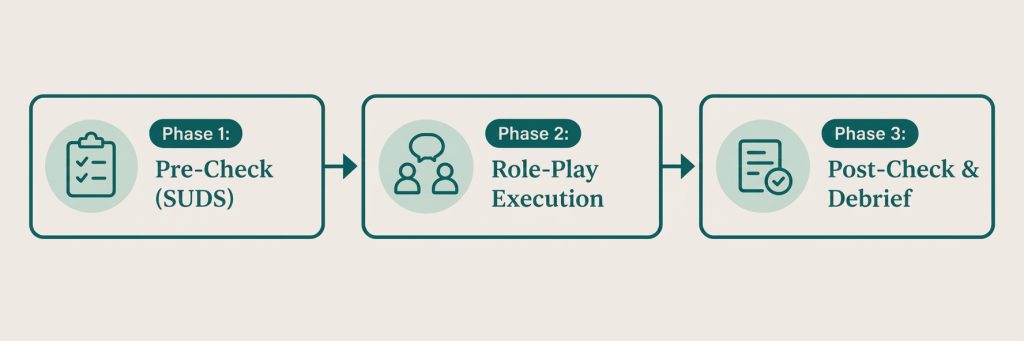
Phase 1: Pre-Assessment & Grounding (3 Minutes)
Check Distress Level: Ask the client to rate their Subjective Units of Distress (SUDS) on a scale from 0 to 10.
If SUDS > 6: Pause and conduct 2 minutes of paced breathing (4-second inhale, 6-second exhale) or sensory grounding before proceeding.
Review Skill Alignment: Confirm the adapted WTW script satisfies DBT DEAR MAN criteria:
• Describe the situation factually.
• Express feelings/opinions clearly.
• Assert wishes directly.
• Reinforce positive outcomes.
• Mindful of the objective (stay focused).
• Appear confident.
• Negotiate where appropriate.
Phase 2: Role-Play Execution (7 Minutes)
Establish Roles: The therapist plays the recipient (e.g., family member, employer, partner); the client delivers the adapted WTW script.
Run Trial 1 (Ideal Scenario):
• The practitioner responds neutrally or receptively.
• The client reads/delivers the WTW script aloud, focusing on tone, eye contact, and pacing.
Run Trial 2 (Pushback Scenario):
• The practitioner responds with mild hesitation, pushback, or deflection.
• The client practices the Broken Record Technique—reasserting the core boundary/request without escalating or losing focus.
Phase 3: Post-Assessment & Debrief (5 Minutes)
Re-evaluate SUDS: Record post-role-play distress level.
Deconstruct Performance: What felt manageable during the WTW script delivery? Where did physical tension or emotional urge to surrender/defend arise?
Consolidate Learning: Reinforce that the primary goal is maintaining self-respect and clear boundary communication, regardless of the recipient’s reaction.
About the Broken Record Technique: An assertive communication strategy where you repeat your core request, boundary, or decision using the same or very similar words, without getting angry, defensive, or off-track. In DBT, this technique is a core part of being Mindful during the DEAR MAN framework.
Protocol 4: Clinician Safety & Digital Privacy Guidelines
1. Digital Hygiene Instructions
Device Security: Advise clients to complete reflective exercises on password-protected personal devices.
Public Wi-Fi: Remind clients not to draft or access sensitive therapeutic content over public or unsecured networks.
2. Crisis & Emergency Boundaries
Not a Monitoring Service: Ensure clients sign an informed consent stating that digital tools and web entries are not monitored by the clinician in real time.
Emergency Protocol: Provide clear written crisis contacts (e.g., 988 Suicide & Crisis Lifeline, local emergency numbers) on all homework instruction sheets.
Downloadable Tools
The following tools are available as free downloads for practitioners and clients. No login or email required.
Client-Facing Script Adaptation
A fillable worksheet for selecting a script, identifying automatic thoughts, and reframing into objective language.
In-Session Role-Play Protocol
A printable copy of the 15-minute role-play protocol for use during sessions and it covers post-debrief phases as a ready-to-use script.
Professional Informed Consent Form
An informed consent template for digital self-directed tools. Available as PDF and editable Word document.
The word document of the consent form is available. Here!
Looking for the client-facing guide? See our Guide for clients.